NGOs + foundations
A tangible program asset with a defined handover, training and measurement framework.
Containerized dairy processing systems · by Crystal Creek
Day One Dairy is a family of factory-built, containerized dairy processing systems for farms, cooperatives and food-security programs—with a disciplined target to commission in one day when the receiving site, utilities, approvals and operators are ready.
*Base Day One Milk module. Final equipment, capacity, site work, freight, taxes, commissioning and local requirements are quoted after a project call.
One brand. A complete deployment pathway.
Day One Dairy is the umbrella for a factory-built modular dairy system. Whether a buyer describes the need as a micro dairy, mini dairy plant or containerized processing plant, each Day One product names a distinct capability, while “by Crystal Creek” keeps engineering, commissioning and support attached to the manufacturer behind the system.
 01 · Core module
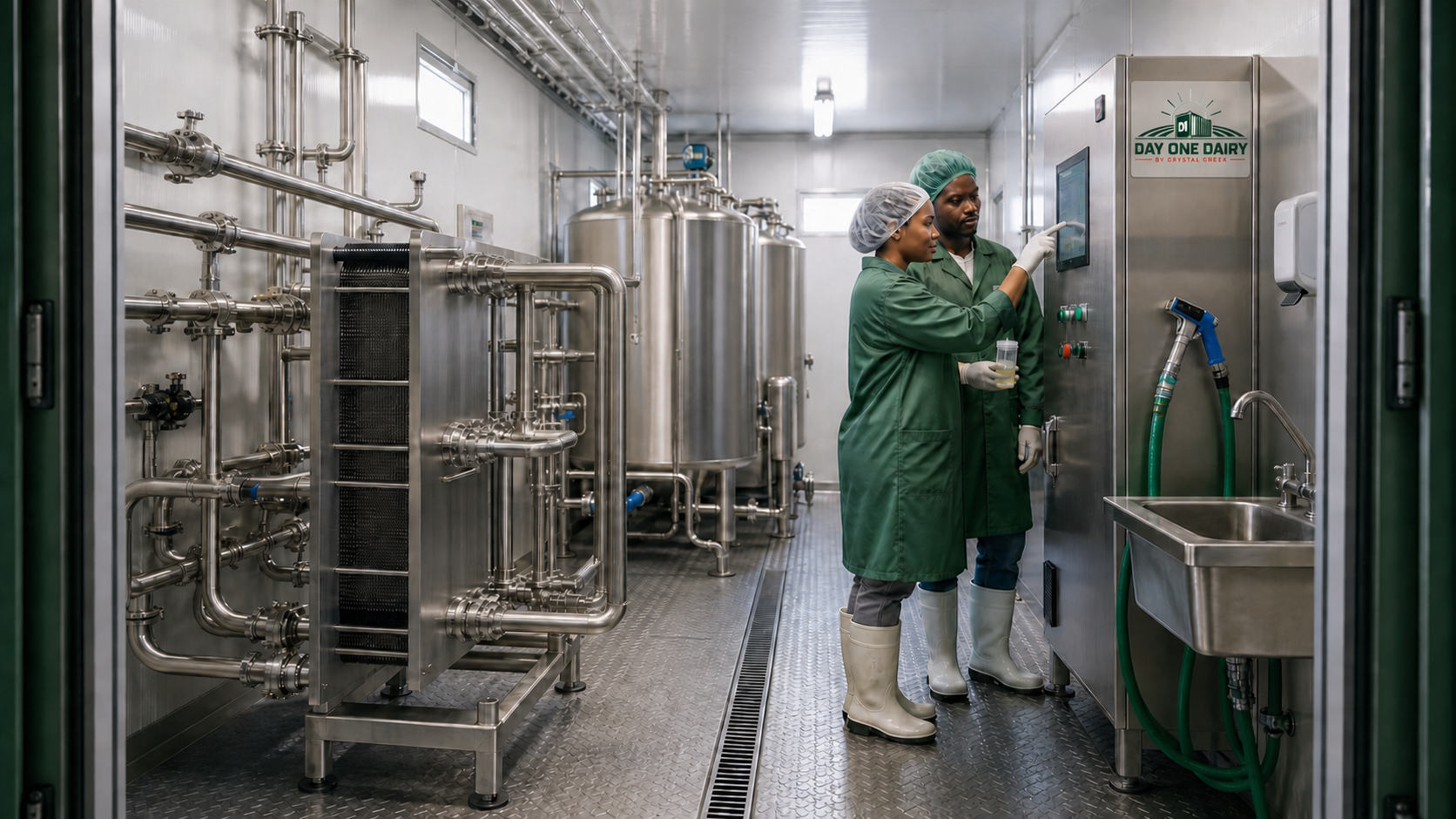
Receive, pasteurize, chill, hold and clean down inside a closed food-grade production environment.
Explore Day One Milk ↗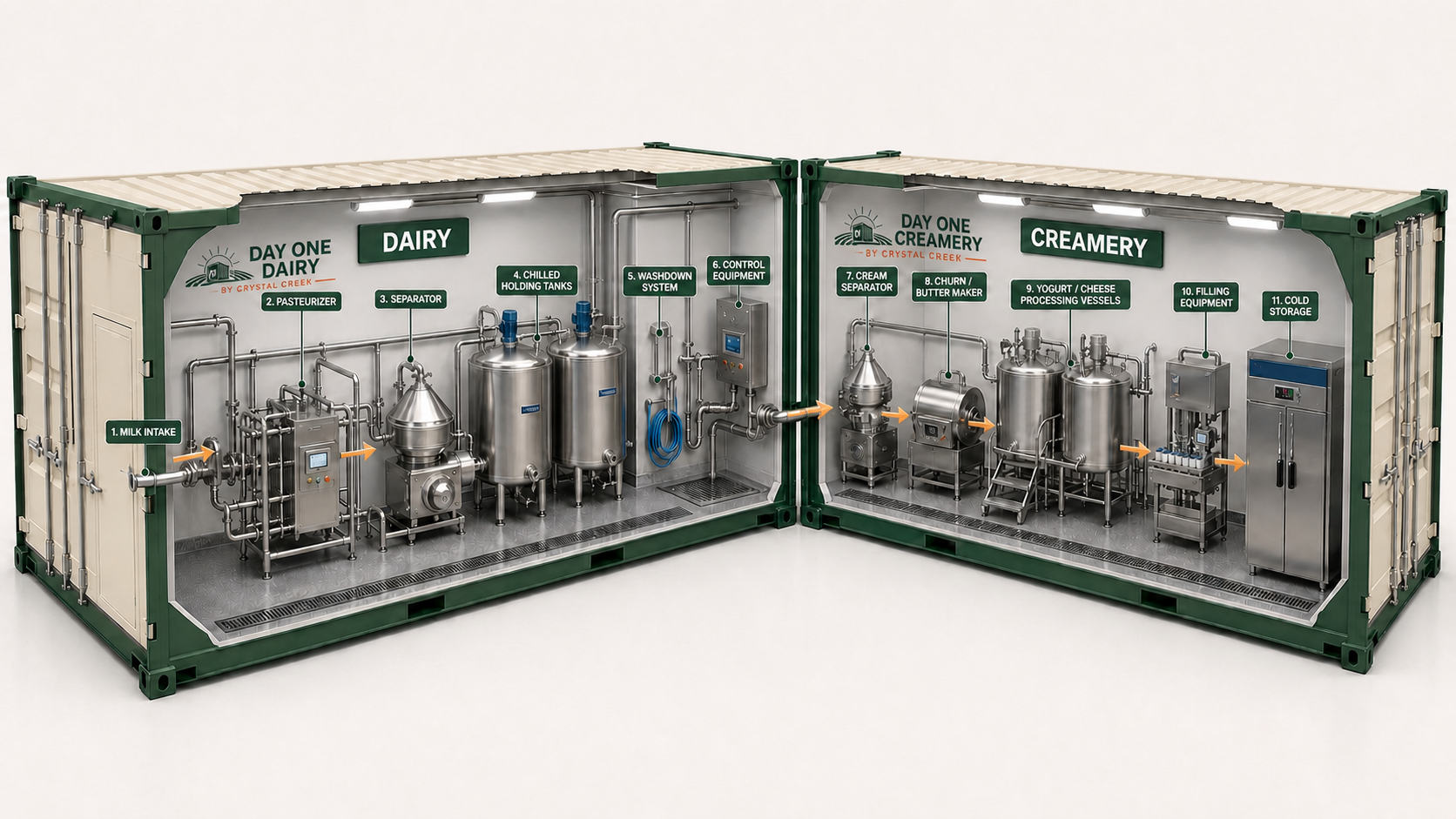 02 · Value-added module
Add yogurt, butter, cream and cheese pathways behind a controlled transfer from the Milk module.
Explore Day One Creamery ↗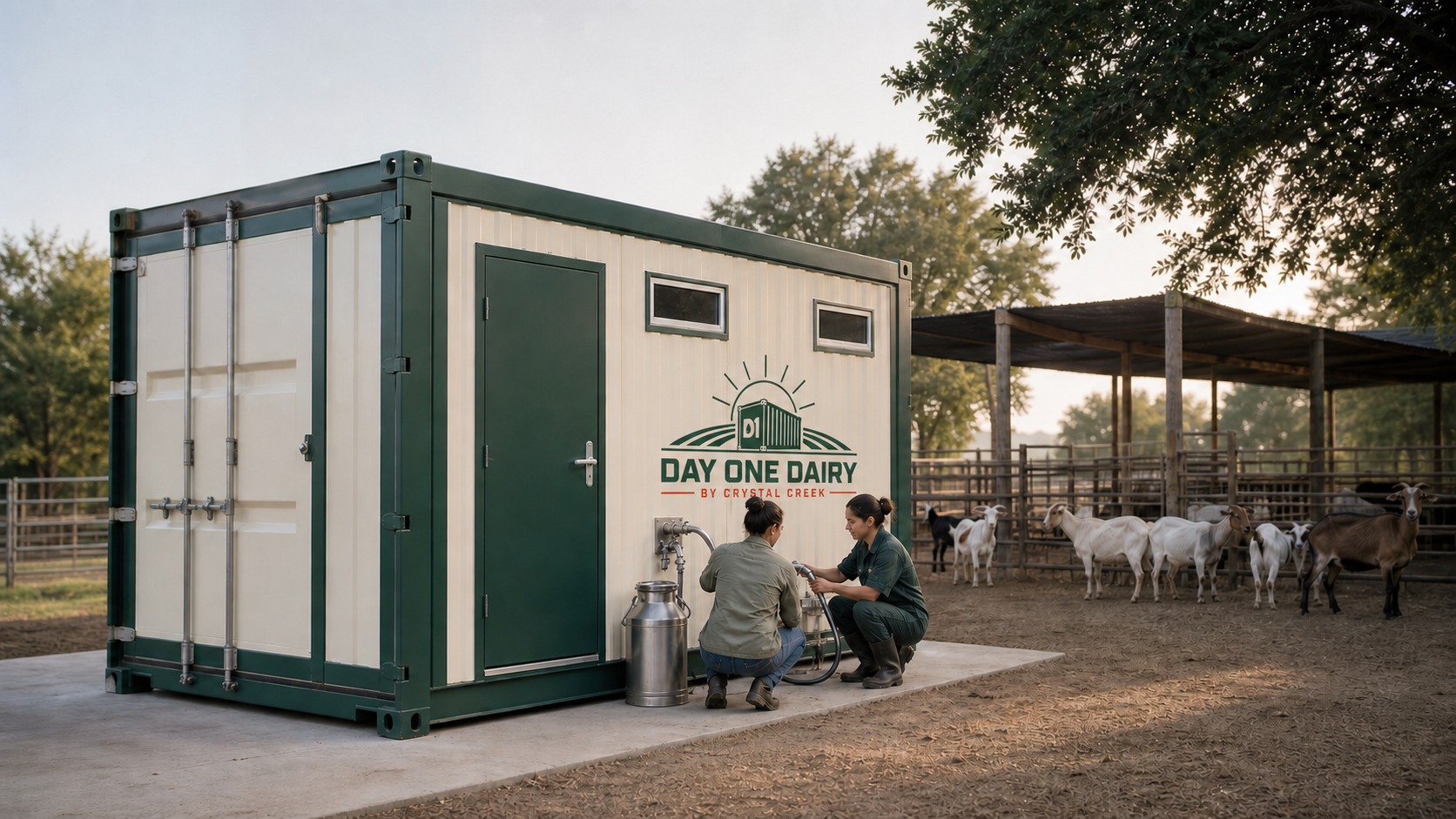 03 · Right-sized module
A compact pathway for goat, sheep and other small-livestock programs.
Explore Day One Goat ↗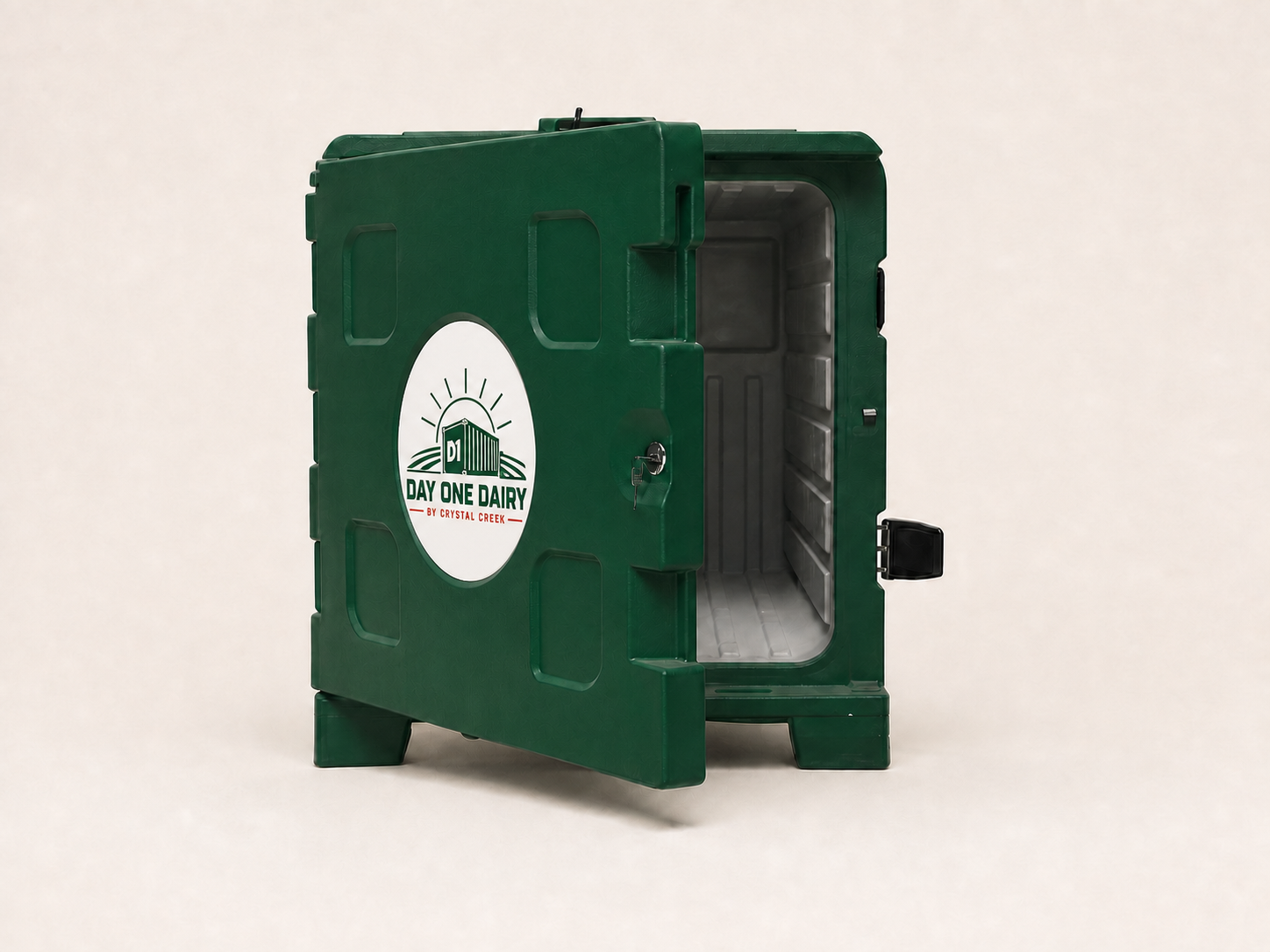 04 · Portable cold chain
Portable chilled or frozen capacity for collection, last-mile delivery and temporary storage.
Explore Day One Rapid ↗Local control with Crystal Creek diagnosis and approved support from anywhere.
See connected operations ↘Buyer and program field guides
These plain-language guides answer the category, site and operating questions buyers ask before a project call. Each one includes the limits and destination-specific responsibilities—not just the sales promise.
 Category guide
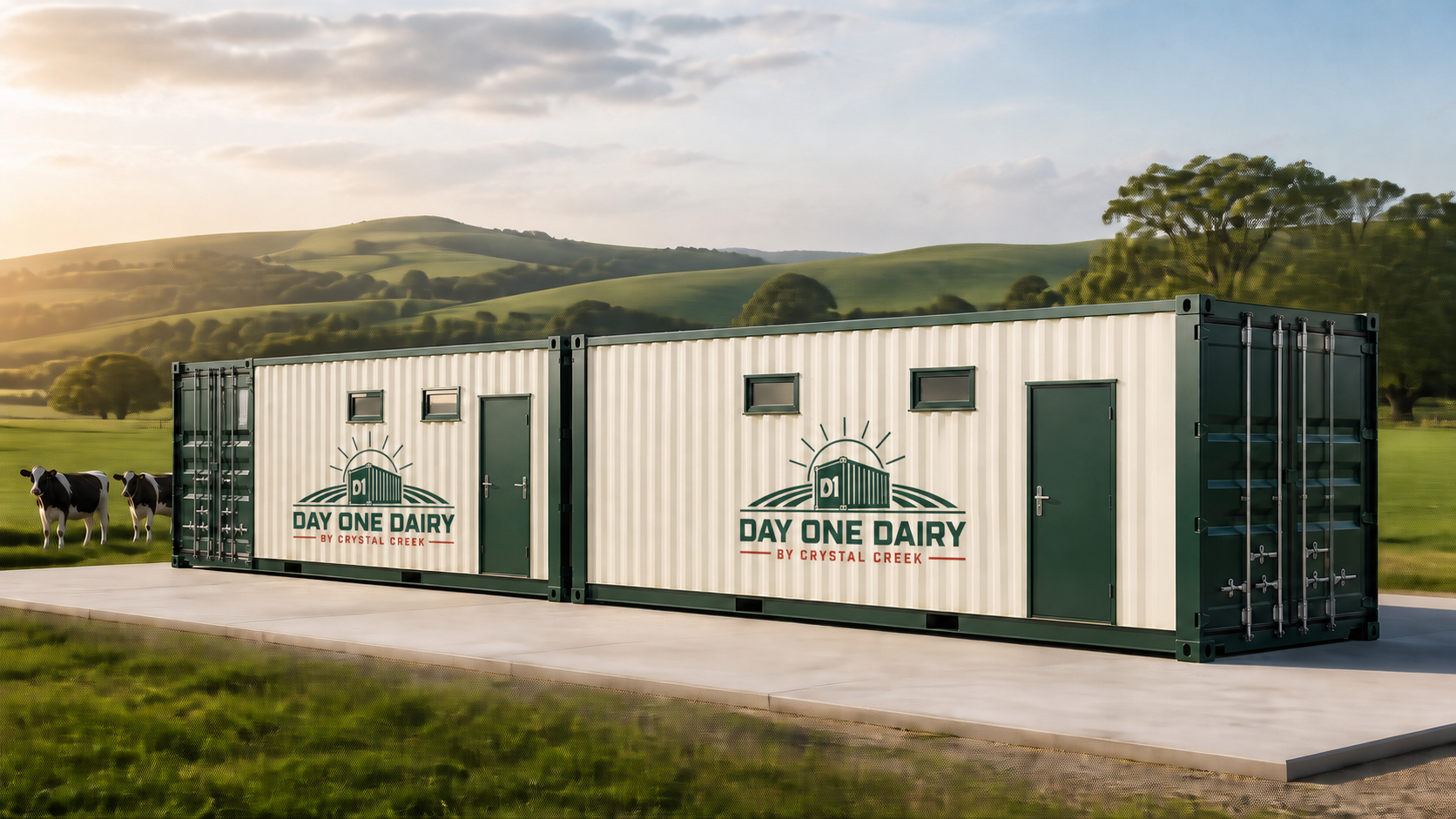
 See how equipment, refrigeration, sanitation, controls and operator workflow become one factory-built system.
Read the guide ↗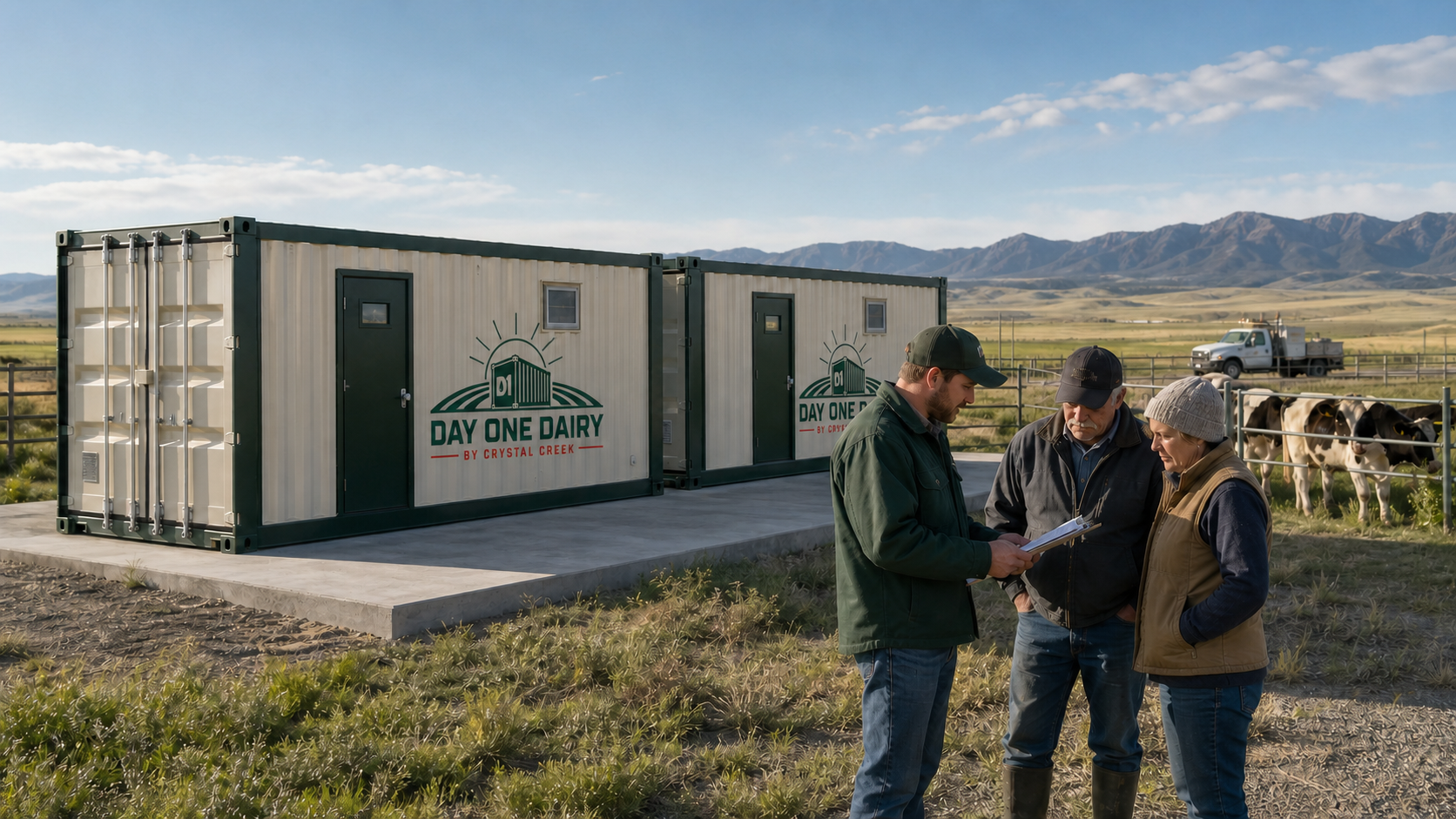 Farm guide
 Plan a right-sized milk pathway around the herd, market, utilities and people who will run it.
Read the guide ↗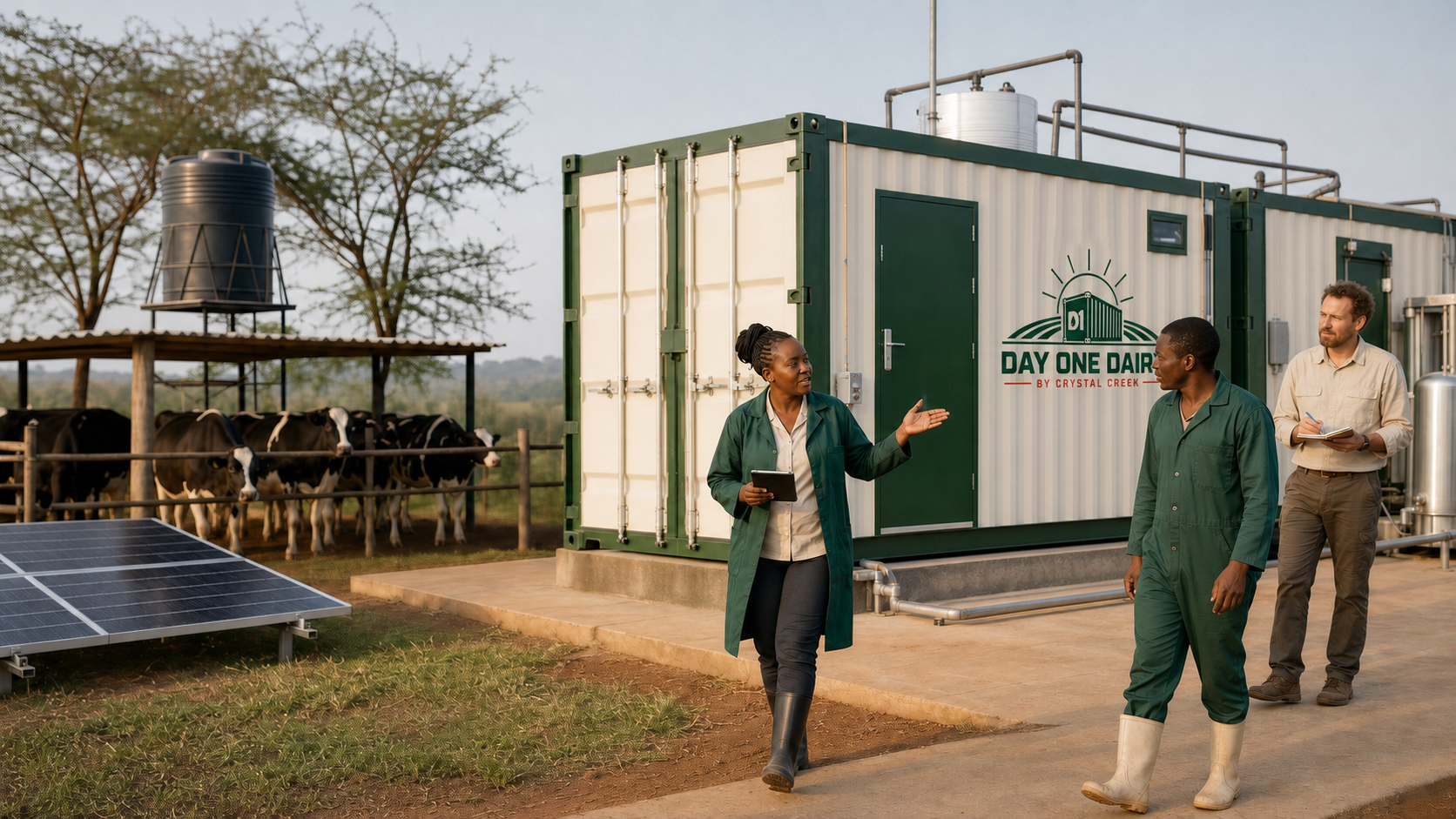 Program guide
 Build equipment, handover, local ownership, maintenance and measurement into one program plan.
Read the guide ↗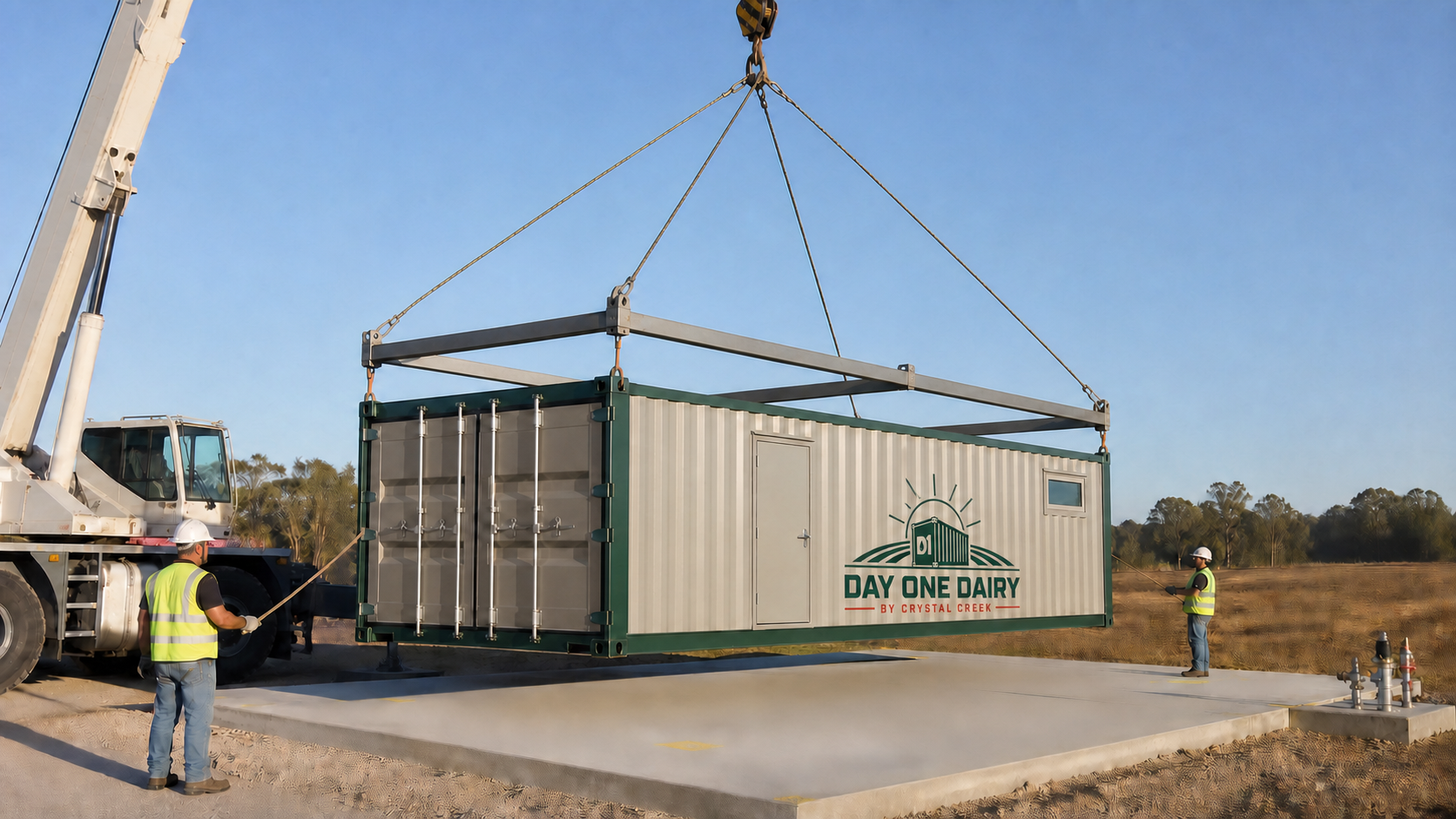 Site guide
 Review access, pad, lifting, power, water, drainage, wastewater, inspections and operators.
Read the guide ↗The case for Day One Dairy
Day One Dairy is conceived for NGOs, foundations, governments and local operators who want a durable production asset—not a short-lived intervention. The objective is practical: process closer to the producer, build skills around a repeatable system and create a pathway toward locally sustained operations.
Impact depends on program design, local governance, market access, utilities, training and maintenance. Day One Dairy provides the production platform and implementation framework; it does not claim outcomes without local evidence.
A tangible program asset with a defined handover, training and measurement framework.
A configurable platform for regional food-processing, cold-chain and workforce initiatives.
A clear physical workflow designed around maintainability, safe routines and business continuity.
A route to on-farm milk processing and greater retained value without starting with a conventional plant build.
The core product
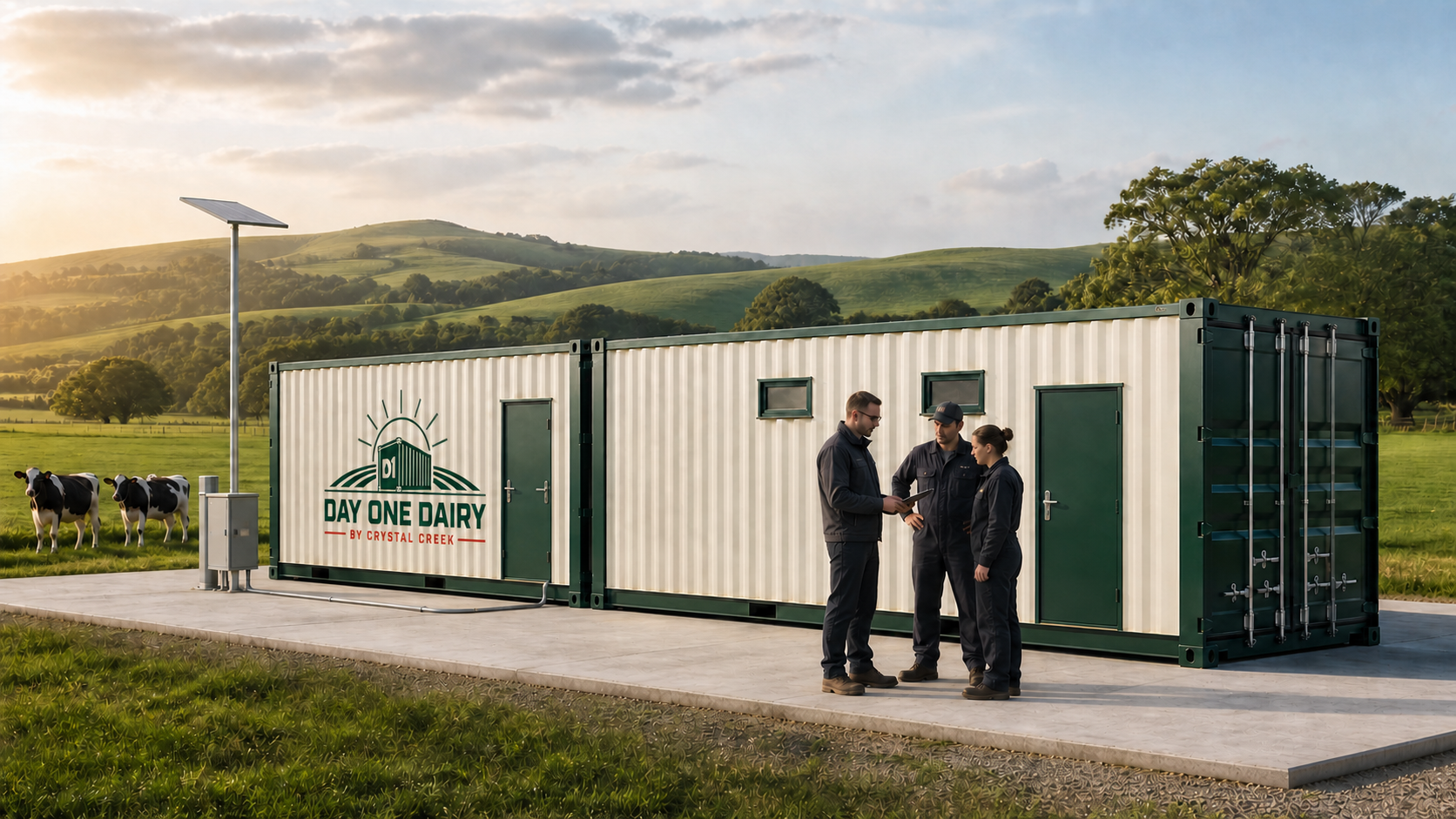
Both units travel as closed, production-only shipping-container modules. Standard cargo doors support access and transport; a personnel door and small high-level windows serve the operating environment. There is no sales hatch and no direct retail from the containers.
Day One Milk
Receive, pasteurise, chill, hold and clean down inside a disciplined food-grade workflow.
Day One Creamery
Configure cream, butter, yogurt and cheese processes, then fill, pack and move into cold storage.
Product architecture
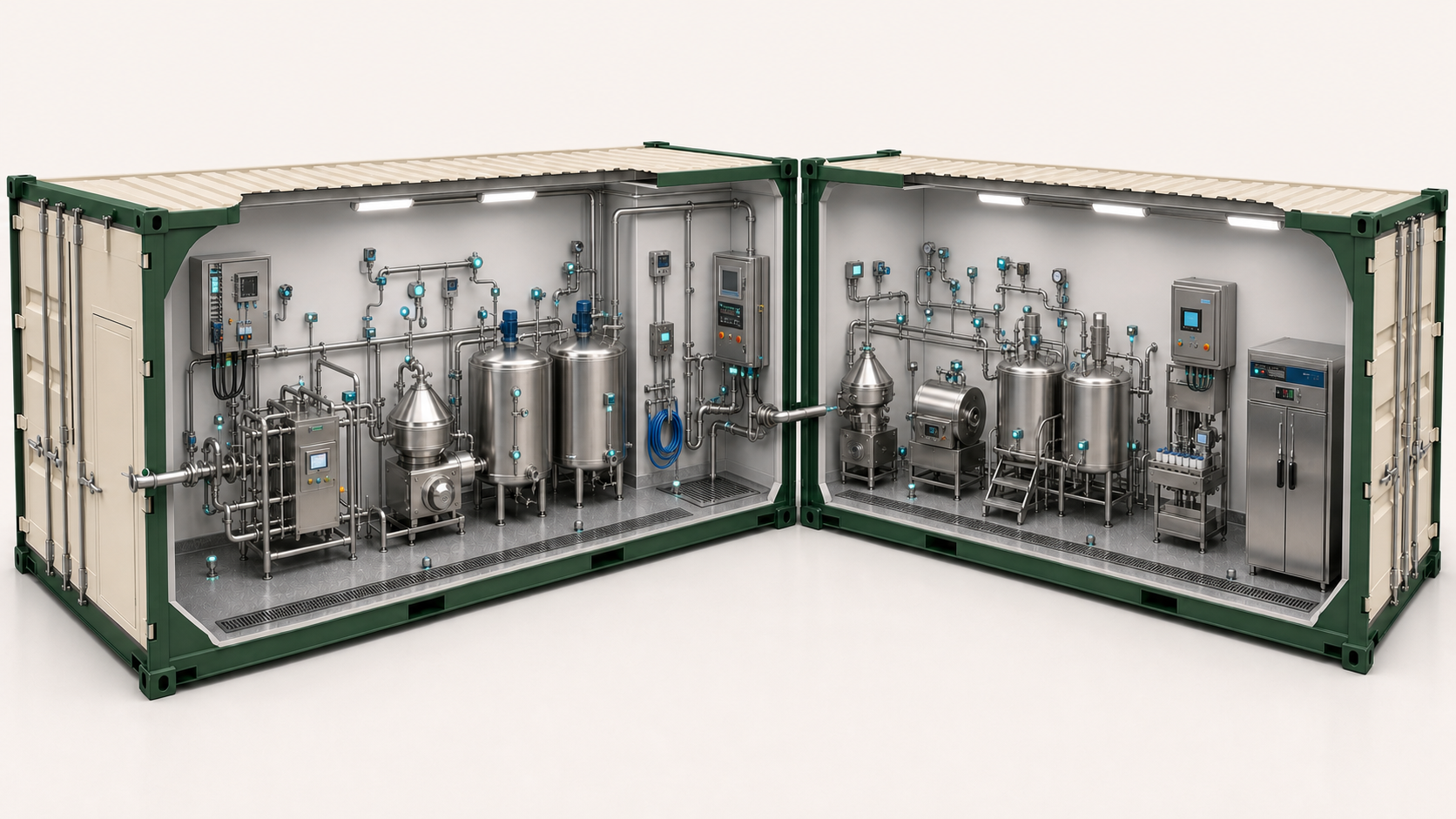
Every finished unit is closed and transport-ready. The cutaway reveals the engineered workflow inside—without turning the exterior into a storefront.
Day One Milk → Day One Creamery System 01
The Dairy module controls the critical first steps: receiving, pasteurisation, chilled holding, sanitation and the hand-off to Creamery.
Equipment, throughput and approval requirements are engineered for the receiving site.
System 02
A separate food-grade environment for configurable cream, butter, yogurt and cheese workflows, filling, packing and cold storage.
Equipment, throughput and approval requirements are engineered for the receiving site.
Field-intake option · Day One Milk
The processing environment stays sealed. A recessed steel roof wing on each long side travels latched against the module, then raises over a configurable external stall bank and gated funnel-entry race at the receiving site.
Engineered for the receiving site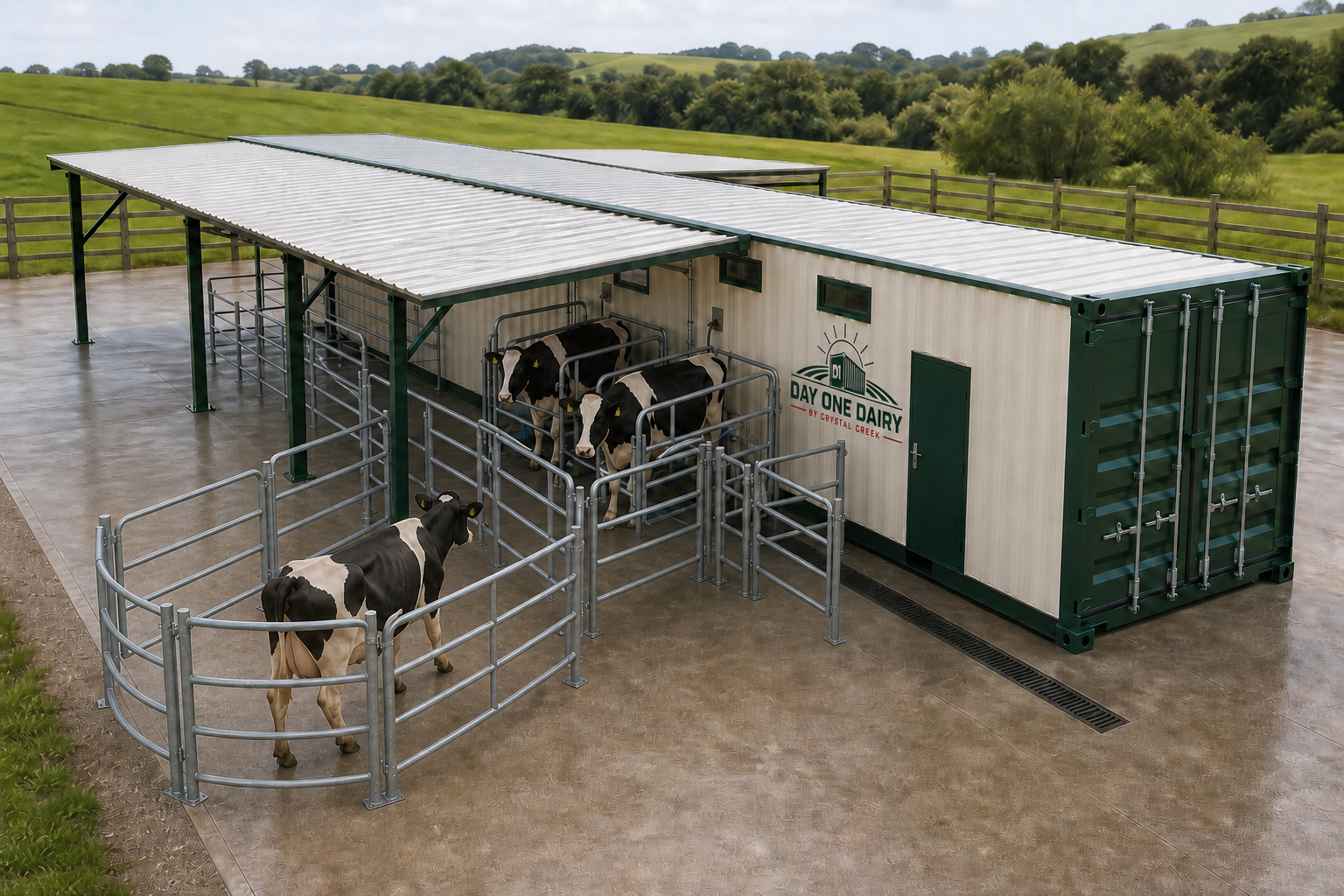
One weather-shedding steel panel deploys from each long side over the stall zone.
Swing-down posts meet prepared anchor plates; locking pins and diagonal braces resist movement.
The insulated Dairy wall never opens. Milk crosses through dedicated sanitary side connections.
A gated race narrows cows to single-file and turns one animal toward the next open stall.
The working bay sits behind the personnel door so access and emergency egress remain unobstructed.
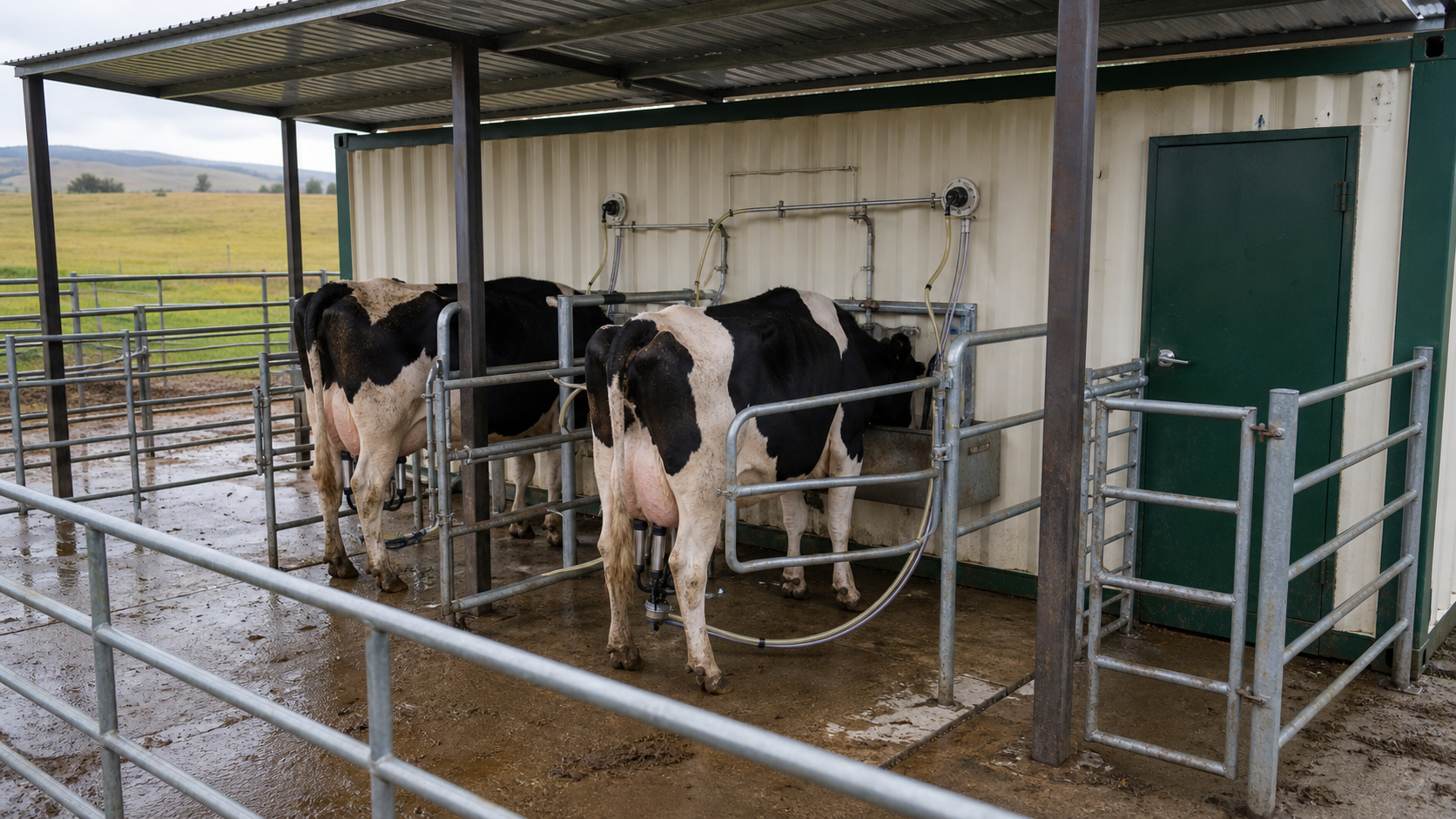
Under the wing
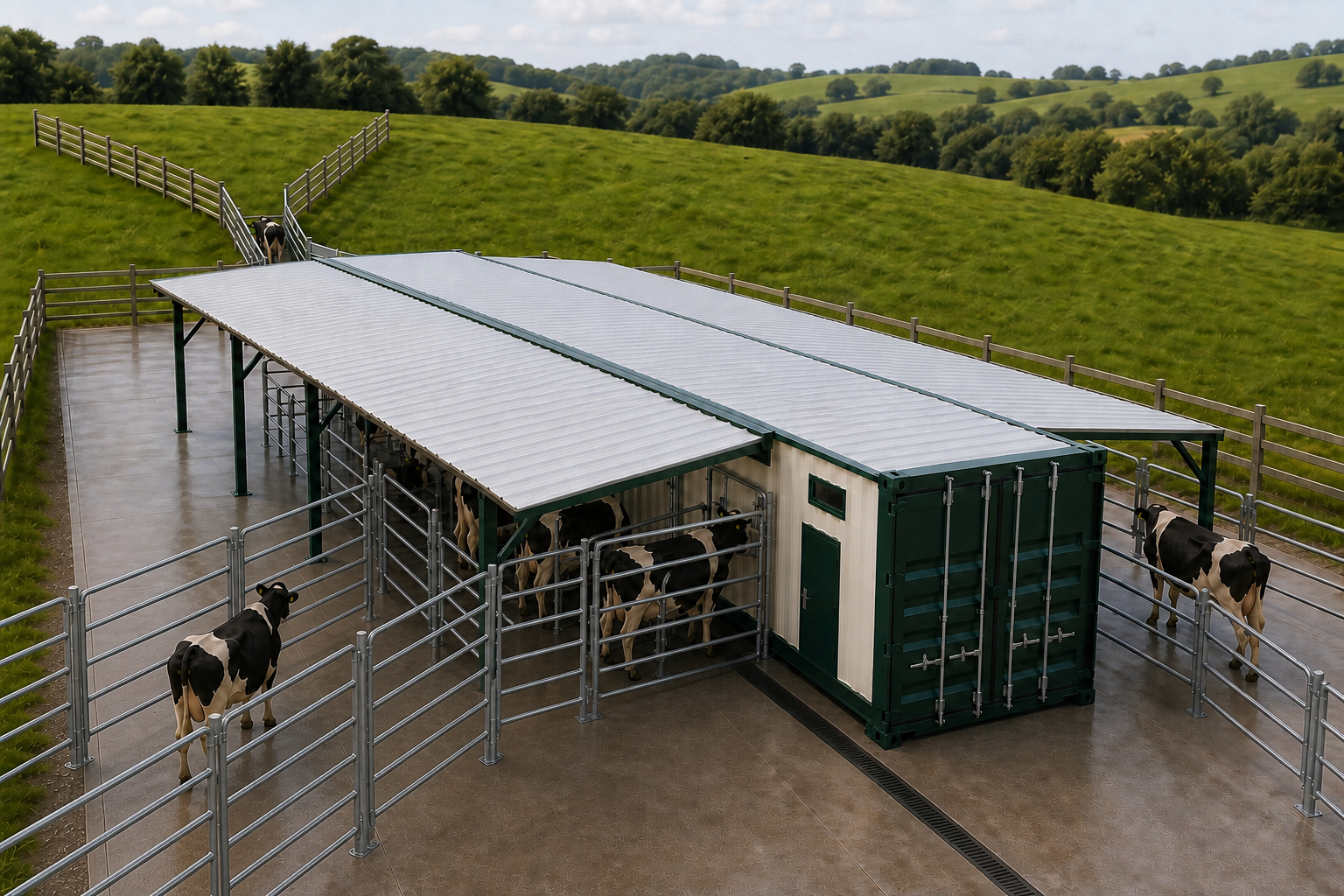
Each cow walks forward into a defined stall and settles at a container-side feed trough. Individual side rails and a controlled rear gate contain the animal while preserving access to the udder and the sanitary wall connections.
Final stall count must match cow size, animal-welfare requirements, operator staffing, vacuum capacity, milk cooling and the receiving site. Two or three stalls is a configuration choice—not a universal claim.
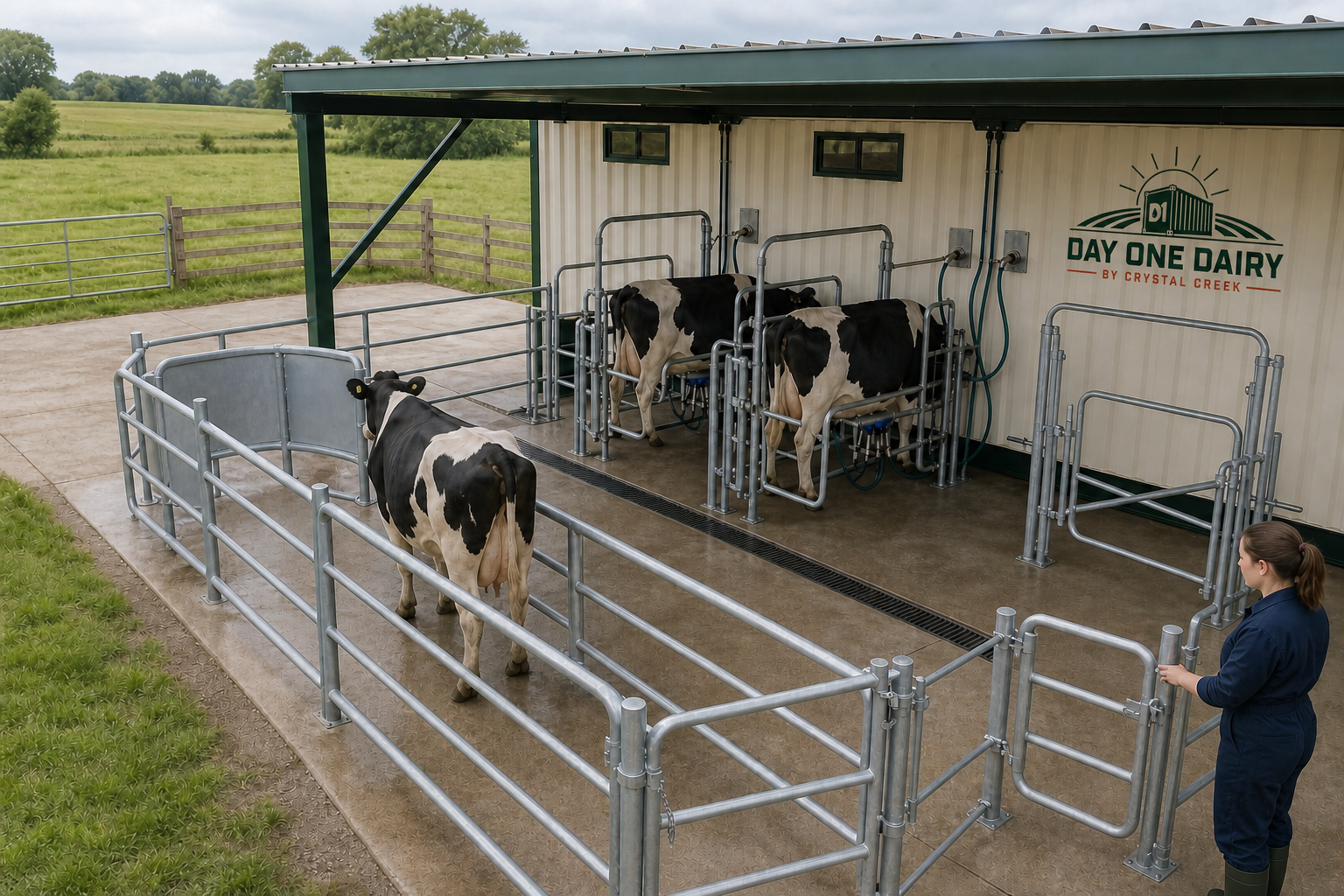
Feed-in channel · animal entry race
The approach channel is a gated cattle race—not the wall-side feed trough. It keeps cows single-file and guides one animal forward into the next available head-in stall. After milking, the cow backs into a controlled return lane without crossing the personnel door.
The rail pack can be designed to bolt together on the prepared slab and travel dismantled inside the module. Final race width, turning radius, gate swing, escape clearances, floor slope and cattle-handling details require local animal-welfare and structural review.
Four-stage field deployment
The exact hinge, lift assist, post, anchorage and transport-envelope details require structural engineering for the destination’s wind, rain, snow and seismic conditions.
Both roof wings lock vertically against recessed side frames. Gates, milking hardware and loose braces travel secured.
A controlled mechanical assist raises the panels from their top hinges while the installation zone stays clear.
Outer posts swing down to verified slab points. Baseplates, locking pins and diagonal braces complete the structure.
Install the selected two- or three-stall bank, verify sanitary connections and drainage, then release the bay to trained operators.
Cows, mud and weather stay outside. The Dairy module remains a closed, cleanable food-production environment at every stage.
Discuss field intake on a project call ↗ Inside Day One Milk · operator controls Inside the operating model
A system only creates value when operators can use it confidently every day. Day One Dairy prioritises clear zones, sanitary transfer, visible controls, washdown logic, maintainable equipment and training that stays with the local team.
Define who receives, processes, verifies, cleans and signs off each batch.
Build repeatable clean-down and verification steps around the actual product mix.
Document service points, spares and escalation before the system leaves the shop.
Train operators and supervisors against the configured equipment—not a generic manual.
Day One Connected
Local control. Crystal Creek expertise, anywhere.
The local team keeps full control of daily production. At the same time, approved system health reaches experienced Crystal Creek engineers—so a rising milk temperature, refrigeration fault or failing pump can be understood before guesswork creates a larger problem.
 Preferred satellite pathProfessionally mounted with protected power and cabling Industrial gatewayControllers are never exposed directly to the internet
 Temperatures, pressures, flows, levels, current, doors, leaks, alarms and equipment state in one labelled view.
Crystal Creek technicians can inspect the sequence and history behind a fault—not just react to a single alarm.
Local teams can ask for informed help without handing the process over to trial-and-error.
Remote evidence helps decide whether the answer is a reset, a part, a local task or an on-site visit.
The PLC, HMI, manual controls and safety systems remain functional without internet; the gateway buffers about 30 days.
One labelled operating picture
The installed point schedule is completed after controller, sensor, cybersecurity and hazard review for the receiving site.
 Dairy Creamery 01 Milk intake 02 Dairy process 03 Local PLC + HMI 04 Connected sensors 05 Industrial gateway 06 CIP + washdown 07 Creamery process 08 Refrigeration 09 Power 10 Water + utilities
 Secure by design
Remote commands are signed, expire quickly and pass identity, freshness, range, equipment-state and local-interlock checks at the gateway before execution. Where supported, certificate-secured OPC UA connects the local controller and gateway.
Included in every new system
Connected Operations is a mandatory engineered package—not a consumer add-on. It includes integration, gateway and network equipment, controls work, factory testing, commissioning and the first 12 months of connected support.
Follow milk intake, safe handling and value-added processing as one connected production line.
Explore the paired system ↗ Day One MilkCore-module coverageMonitor the critical receiving, pasteurization, chilling, holding and sanitation sequence.
Explore Day One Milk ↗ Day One GoatRight-sized coverageApply the same connected operating principles to the configured smaller-livestock pathway.
Explore Day One Goat ↗Continue proactive review and remote engineering support after the initial operating year. Scope, response window and included support are defined in the service agreement.
Discuss connected support ↗Request remote diagnostic help when a specific operating question or fault needs Crystal Creek experience. Availability and response are confirmed when support is requested.
Ask about on-demand support ↗Connectivity: Starlink is the preferred deployment connection where legally available. Day One Connected includes mounting, protected power/cabling, secure integration and commissioning; the local partner owns the business account and subscription.
Built here. Working there.
Day One Dairy shifts work out of the field and into a controlled build environment. The modules are configured, fitted and tested before dispatch. When the receiving site is genuinely ready, the target is commissioning in one day.
Before shipment
Access, pad, lifting plan, power, water, drainage, local approvals and operator availability.
Arrival
Rig and set Dairy and Creamery in the engineered orientation on the prepared foundation.
Connection
Connect approved power, potable water, drainage, refrigeration interfaces and data as configured.
Commissioning
Run checks, sanitation verification, operator orientation and the configured startup protocol.
Site readiness, customs, access, utilities, local inspection, weather and final configuration can change commissioning time.
The site-ready standard
One-day commissioning is earned through disciplined preparation. Day One Dairy aligns the receiving team, civil works, utilities and approvals while the modules are being built.
Request the site-readiness brief ↗Verified route, turning radius, lifting clearance, crane setup and security.
Engineered pad, drainage route, elevations and module fixing points.
Approved electrical service, potable water, wastewater and backup plan.
Named operators, local technical partner, inspection pathway and startup authority.
For NGOs and food-security partners
The strongest deployment is locally led from the beginning. Day One Dairy’s program framework connects equipment, people, routines, maintenance, governance and measurement around one production platform.
Operator and supervisor training tied to the actual configured line.
Cleaning, maintenance, spares and escalation planned before dispatch.
Define throughput, uptime, training, product and local-value indicators before launch.
Design for a locally owned operating model and viable route to market.
Country programs are developed with local partners and require feasibility, safeguarding, market and regulatory assessment.
The commercial lane
For homestead and small dairy operators, Day One Dairy offers a staged alternative to a conventional greenfield build: start with Day One Milk, add Day One Creamery when the product line and market are ready, and configure the site around the farm that already exists.
Day One field stories
Use the controls to walk a board, donor or farm partner through the whole story. This branded briefing sequence is structured to become a full production film.
01 / 05
Product pathway 03
Not every operation needs the full two-module starting point. Day One Goat is conceived as a compact production pathway for goat, sheep and other small-livestock programs—using the same principles of hygiene, maintainability and local operator confidence.
Product pathway 04 · portable cold chain
A portable refrigerated or frozen cube can close the gap between milk collection, the processing site and local delivery—without asking every route to begin with a refrigerated truck.
Place portable temperature-controlled capacity on a pickup or light commercial vehicle.
Move finished products through a controlled local cold-chain route.
Add temporary chilled or frozen holding for events, peaks or service interruptions.
Specified per order: Crystal Creek confirms the selected cold-cube model, capacity, temperature range, power, local compliance, warranty and delivery requirements for the receiving operation.
Discuss Day One Rapid ↗Day One Rapid cold-chain unitPortable cold-chain equipment for collection, delivery and temporary temperature-controlled storage.
Distributed and configured under Day One Dairy · final specification confirmed per order.Target 12-week build
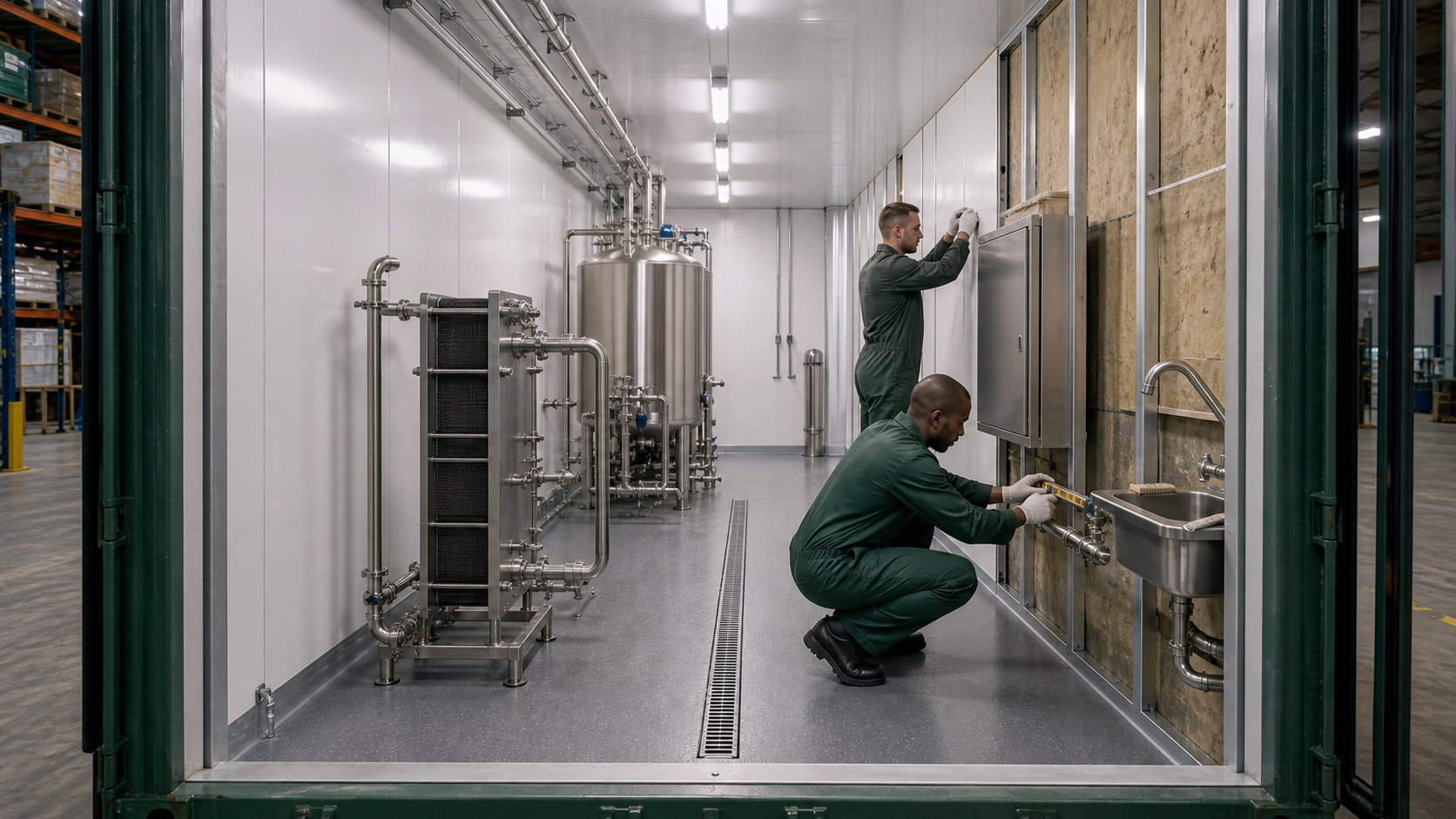
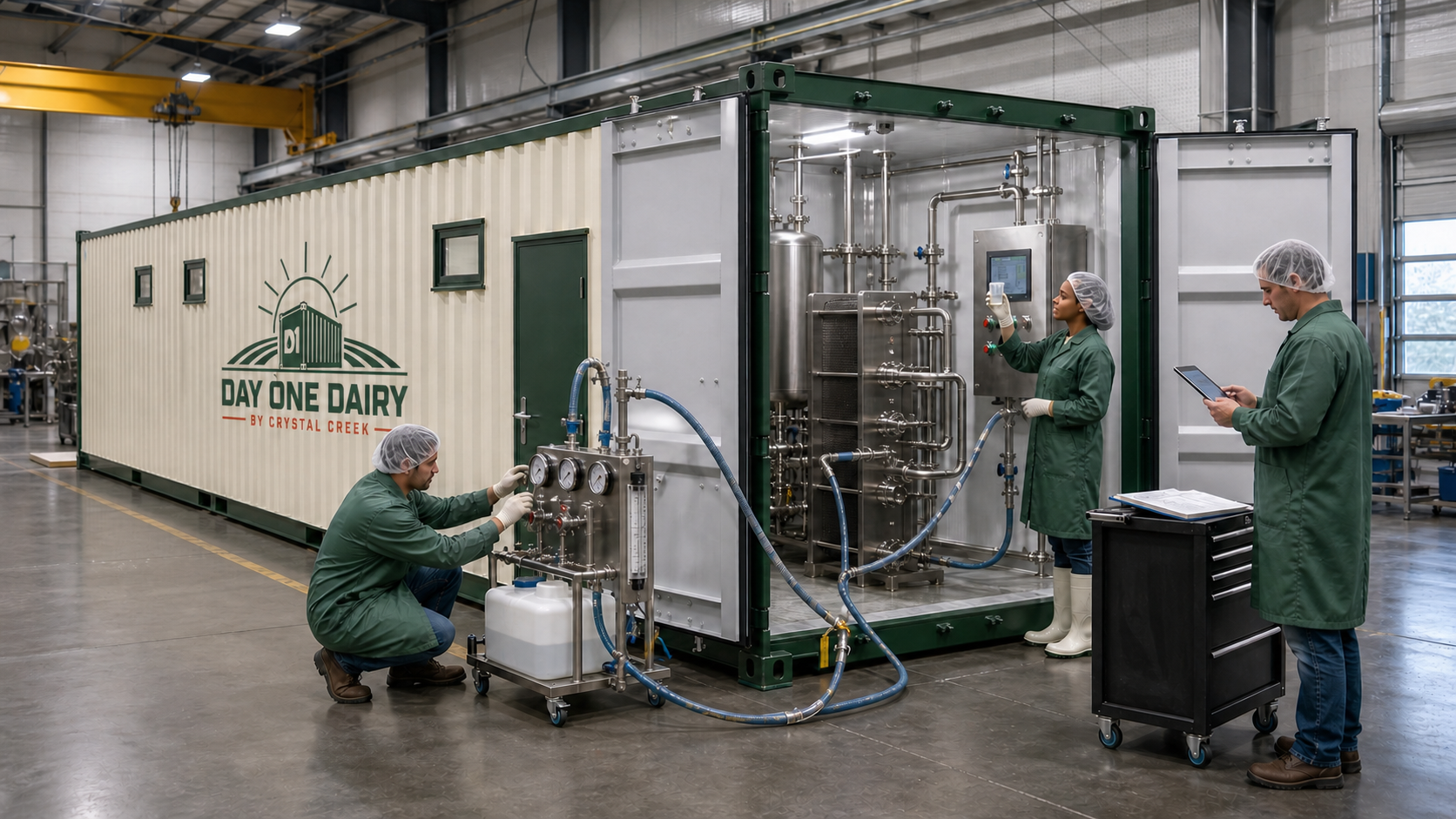
Day One Dairy is configured, structurally prepared, lined, fitted, wired, piped and tested before it enters the shipping lane. That controlled sequence is what makes a fast field commissioning target credible.
Lead time begins after scope lock and build release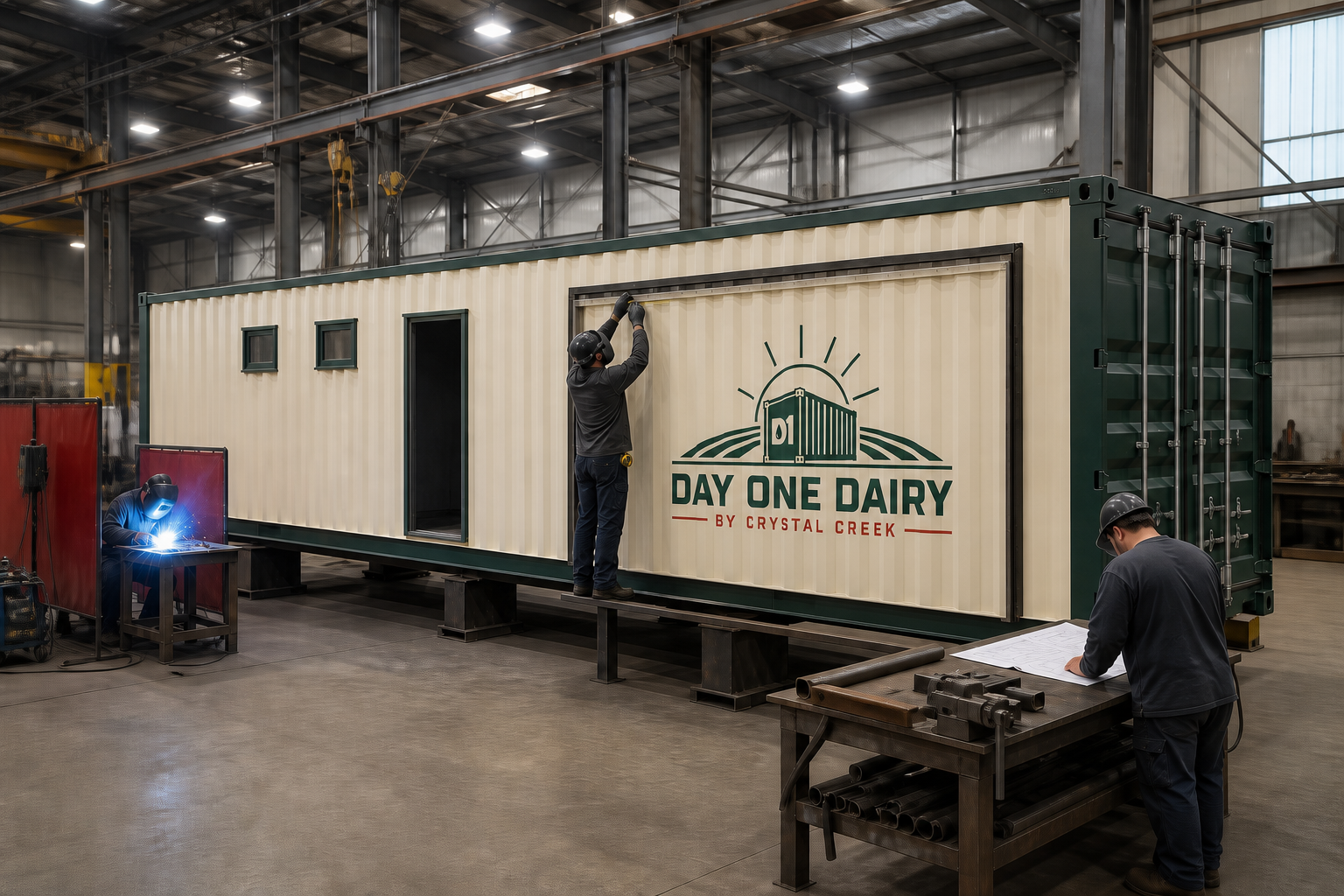
Scope lock
Lock the brief around what the receiving team can run, clean, maintain and sell or distribute.
Engineering release
Coordinate the production flow, equipment, sanitary zones and every connection the site must provide.
Shell + structure
Inspect the base container, reinforce every opening and establish the corrosion and weather boundary.
Systems fit-out
Complete the hygienic envelope, then integrate process, refrigeration, electrical, controls and cleaning systems.
Factory acceptance
Use controlled checks to verify what can be proven before product commissioning at the receiving site.
Dispatch + mobilisation
Secure the modules for transport only after the shipping plan and receiving-site readiness gates agree.
Planned handover package
The final package follows the configured system and approval pathway; these are the core deliverables Day One Dairy is designed to organise.
Book a project call ↗The 12-week target depends on scope lock, equipment availability, engineering review, project approvals, shipping route and receiving-site readiness.
Compliance pathway
Define hazards, sanitation, monitoring and records around the local product and process.
Resolve power, water, wastewater, access, lifting and environmental requirements locally.
Maintain configured manuals, service points, spare strategy and equipment identification.
Work with the receiving partner and relevant local agencies to establish the approval route.
Planning your Day One Dairy
Crystal Creek matches each production system to its herd, products, capacity, utilities, destination and operating team before finalizing the order.
It is the starting price for the base Day One Milk dairy module before destination-specific equipment, capacity, cattle-management hardware, site work, utilities, freight, taxes, commissioning and local approval requirements. Crystal Creek confirms the final scope and price after a project call.
That is the target for a fully pre-prepared site: the pad, access, power, water, drainage, lifting plan, local inspections and operators must all be ready before arrival. Site conditions, local approvals and final configuration can extend the schedule.
No. The containers are production environments, not storefronts. Finished products move into an approved local distribution, institutional or retail channel outside the modules.
No. Every cow remains outside beneath a deployed steel roof wing. A permanent insulated wall preserves the production boundary, and milk passes through dedicated sanitary connections. A compact bank can be studied with two or three separated stalls; final stall count, hinges, posts, anchors and weather loads require destination-specific engineering.
The system uses a gated single-file approach race to present one cow to the next available head-in stall. The cow walks forward to a container-side feed trough, remains enclosed during milking and then backs into a controlled return lane that stays clear of the personnel door. Final dimensions and handling details are matched to local cattle and animal-welfare requirements.
Day One Dairy is engineered and delivered by Crystal Creek USA, a family business with dairy, refrigeration and fabrication experience. Crystal Creek remains the manufacturer and technical authority behind every configured system.
The module logic is repeatable, but equipment, throughput, product mix, utilities, climate package and approval pathway are configured around the receiving site and local operator.
The target covers configuration, engineering, fabrication, fit-out, testing and dispatch planning after the scope is locked. Custom equipment, approvals, shipping lanes and site readiness can change the final schedule.
Production keeps running locally. The PLC, HMI, manual controls, interlocks and safety systems do not depend on the cloud. The industrial gateway is designed to buffer about 30 days of operating data and synchronize it after a connection returns.
Only authorized Crystal Creek engineers can issue allow-listed commands, and every request requires a reason, a two-step confirmation and a permanent audit record. The gateway still checks identity, command freshness, engineered limits, equipment state and local interlocks before execution. Local operators see only their own deployment; Crystal Creek engineers can see the supported fleet.
No. Emergency stops, safety relays, protective cut-outs, animal gates and folding roof mechanisms are monitor-only from the remote console. Remote commands cannot rewrite the PLC program or bypass local safety logic.
Starlink is the preferred connection where it is legally available and approved for the receiving site. Day One Connected includes the specified mount, protected power and cabling, secure network integration and commissioning. The local partner owns the appropriate business account and subscription; country availability, plans and approvals can change.
Day One Rapid provides portable cold-chain capacity for farm pickup, last-mile delivery and temporary chilled or frozen storage. Crystal Creek confirms the model, temperature range, power, local compliance and warranty for each order.
No. The technical connection can remain available continuously, but staffed support response is during published Crystal Creek business hours. Response targets and any project-specific escalation coverage are defined in the support agreement.
Deployment owners retain ownership of their operating data. The final agreement defines authorized Crystal Creek access for support, retention periods, exports, security responsibilities and any required program reporting.
Start with a conversation
Tell us about the herd, site and product goals. Crystal Creek will confirm whether the $29,999 starting configuration fits and outline the next practical step.